 Customer Support
 Subscribe
.png?ts=1753705835)
.png?ts=1753705897)



Preorder items are not yet available. The quantity available and "in stock" notations are the quantities we have available for advance order.
If there are other items on the order, the entire order will not ship until all preorders release.
Image, contents, and release date are subject to change.
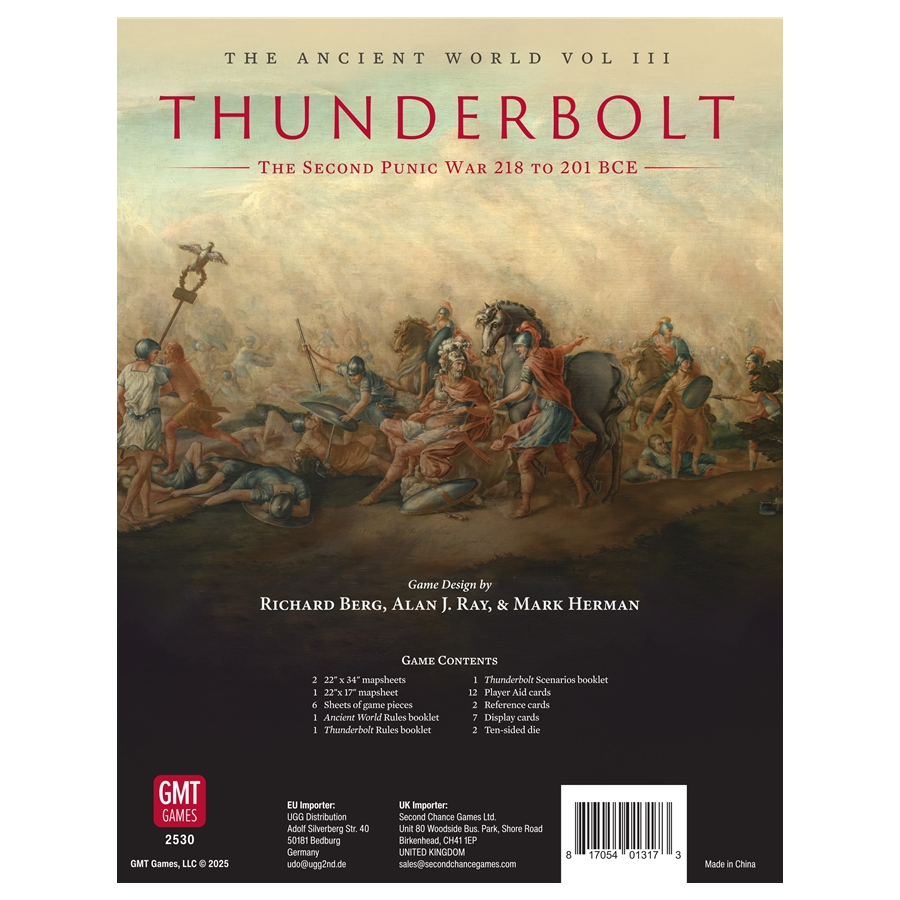
Thunderbolt brings The Ancient World system to the mammoth 2nd Punic War. The game covers the action in the Western Mediterranean on updated Italy and Africa maps published in the prior two volumes, plus a connecting full-size map of Spain and western Mauretania, the last map design of Richard's long and illustrious career.
The Ancient World system uses a chit pull mechanic to drive the action with the better leaders having more opportunities to act. There are no movement allowances; instead attrition and the ability of a leader to continue to conduct operations govern how forces can move. Battles are straightforward, resolved with a couple of die rolls and an extensive list of modifiers to account for cavalry superiority, elite status, and leadership, as well as numbers of troops. The Battle Results Table features an "Unpredictable Result" which can turn the tables on the best laid battle plan. All the trappings around the decisive moment are there as well: Interception, Avoidance, Coordination, Retreat, Pursuit & Butchery, and after battle effects. Sieges are covered in detail, including rules for attrition, assaults, repair and reduction, treachery, and surrender. And what would a Richard Berg game be without random events - Auguries in this system.
The Ancient World system models the Roman and Carthaginian political systems which provide a framework for campaigning during the Game Turn/year. A hierarchy of magistrates commands the Roman Legions in the field: Consuls, Proconsuls, Praetors, and occasionally a Dictator. These magistracies are filled from a pool of over 60 historical personages meticulously assembled by Richard from the sources and individually rated for their capabilities (or lack thereof). Each magistrate is given an Imperium, one or two Legions to command, and a specific area on the map to conduct operations. Changes to the area of operations may change while campaigning but only by permission from the Senate.
The Carthaginians also have a hierarchy of army commanders: Overall Commander, Army Commander, and Subordinate Commander drawn from a pool of over 20 historical personages rated in the same manner as the Roman leaders. Unlike the Romans, the commanders are permanently assigned to a specific army unless recalled or other circumstances dictate otherwise. The Carthaginian family in power and the overall Carthaginian political climate is determined each Game Turn/year. The results determine how many armies the Carthaginians will field and where they can campaign. Hannibal and his army are an exception - he can come and go as he pleases.
New to The Ancient World system are the Celtic and other tribes that populated the Iberian peninsula and northern Italy. These tribes, over 20 in number, are represented on the map with counters rated for Aggression and the ability to provide troops. Each tribe can be either allied to Rome or Carthage or Neutral. Tribes can be used to attack the player's opponent or provide troops. Tribes can be attacked and pacified. Diplomacy can be used to alter a tribe's allegiance.
Naval matters are not ignored, but due to the paucity of significant naval engagements, the scenarios use The Ancient World's simpler Naval Superiority System to streamline play.
Thunderbolt features several smaller scenarios (most playable on a single map) along with the 2nd Punic War grand campaign played on all three maps. The planned scenarios include:
• 2nd Punic War: The entire 2nd Punic War. Three maps, 16 Game Turns. A wealth of special rules to bring this conflict into sharp focus.
• Thunderbolt: Hannibal's Invasion of Italy. One map, 3 Game Turns (218-216 BCE). A reappraisal of the scenario from Rise of the Roman Republic. An excellent introductory scenario.
• Italian Campaign: Hannibal's campaign in Italy. One map, 16 Game Turns (218-203 BCE)
• The Spanish Campaign I: The Roman Invasion of Spain. One map, 8 Game Turns (218-211 BCE).
• The Spanish Campaign II: Scipio Strikes Back. One map, 5 Game Turns (209-205 BCE).
• The Island Contest: The Carthaginian Invasions of Sicily and Sardinia. Two maps, 5 Game Turns (215-211 BCE)
• The African Campaign: Scipio Africanus' Invasion of Africa. One map, 3-4 Game Turns (204-201 BCE)
• Iberia: Carthage's Conquest of Spain. One map, approximately 16 Game Turns (237-220 BCE)
Note: This Standard Edition is packaged in a plastic bag.
Ages: 14+
Players: 1-2
Game Length: 60-180 minutes
Customer reviews are disabled until you allow the Reviews.io service. Change cookie preferences
You want to be informed when the price of Thunderbolt: The Second Punic War 218-201 BCE (Standard Edition) (Preorder) reaches a certain value? If so, please specify your desired price below.
Related Products